22 Small Living Room Ideas That Make Your Space Feel Bigger
A small living room is not a problem to fix — it is a puzzle with a very satisfying solution. Some of the most loved, most saved living rooms on Pinterest are tiny ones, because every single choice in them was made on purpose.
The secret is not buying smaller versions of everything. It is choosing pieces that work harder, colors that open the room up, and arrangements that give you breathing room where it counts. These twenty-two ideas are the ones that truly move the needle, whether your living room is a compact apartment corner or a cozy little cottage room.
Start with the layout ideas — they are free — then add color and light, and finish with the storage tricks that keep a small room from tipping into cluttered.
In this guide
- Layout Moves That Instantly Add Space
- Color & Light Tricks That Open the Room Up
- Storage & Styling That Keeps It Calm
- More Small-Room Ideas That Earn Their Space
- Small Living Rooms for Real Life
- The Vertical Half of the Room
- How to Recreate These Ideas in the Right Order
- Real-Life Problems, Solved
- Budget Guide: Where to Save, Where to Spend
- Mistakes to Avoid
- Your Small Living Room Checklist
- Frequently Asked Questions
Layout Moves That Instantly Add Space
In a small room, where things stand matters more than what things are. These first moves cost nothing and change everything.
1. Float the Sofa Off the Wall
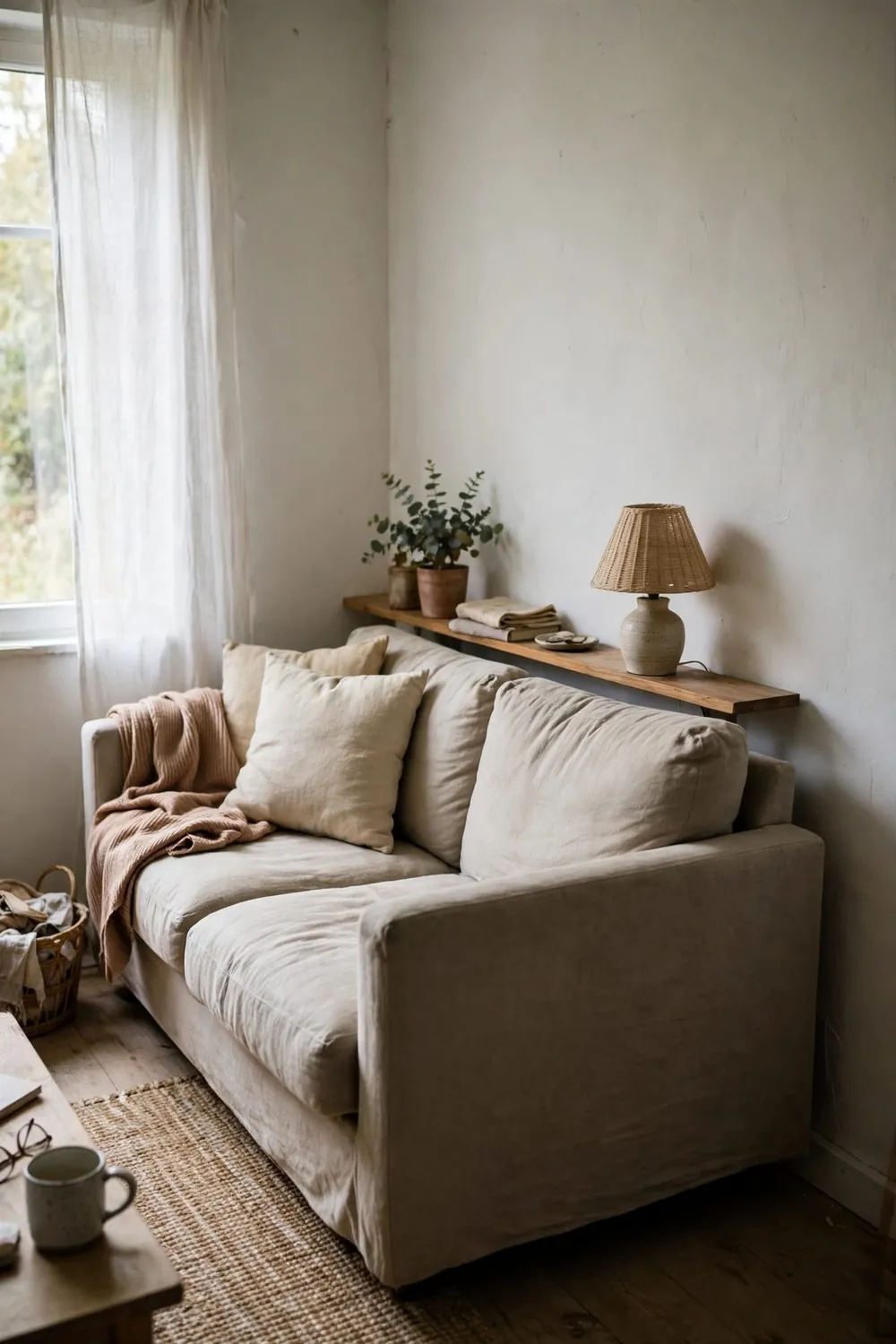
It sounds backwards, but pulling your sofa even four to six inches away from the wall makes a small room feel bigger, not smaller. The sliver of shadow behind it tricks the eye into reading more depth, and the arrangement feels intentional instead of pushed-back.
If you have the room, float the sofa fully with a narrow console or shelf behind it. That shelf becomes storage and a home for a lamp and a plant — in a room where every surface earns its place.
2. Choose One Statement Piece and Keep the Rest Quiet
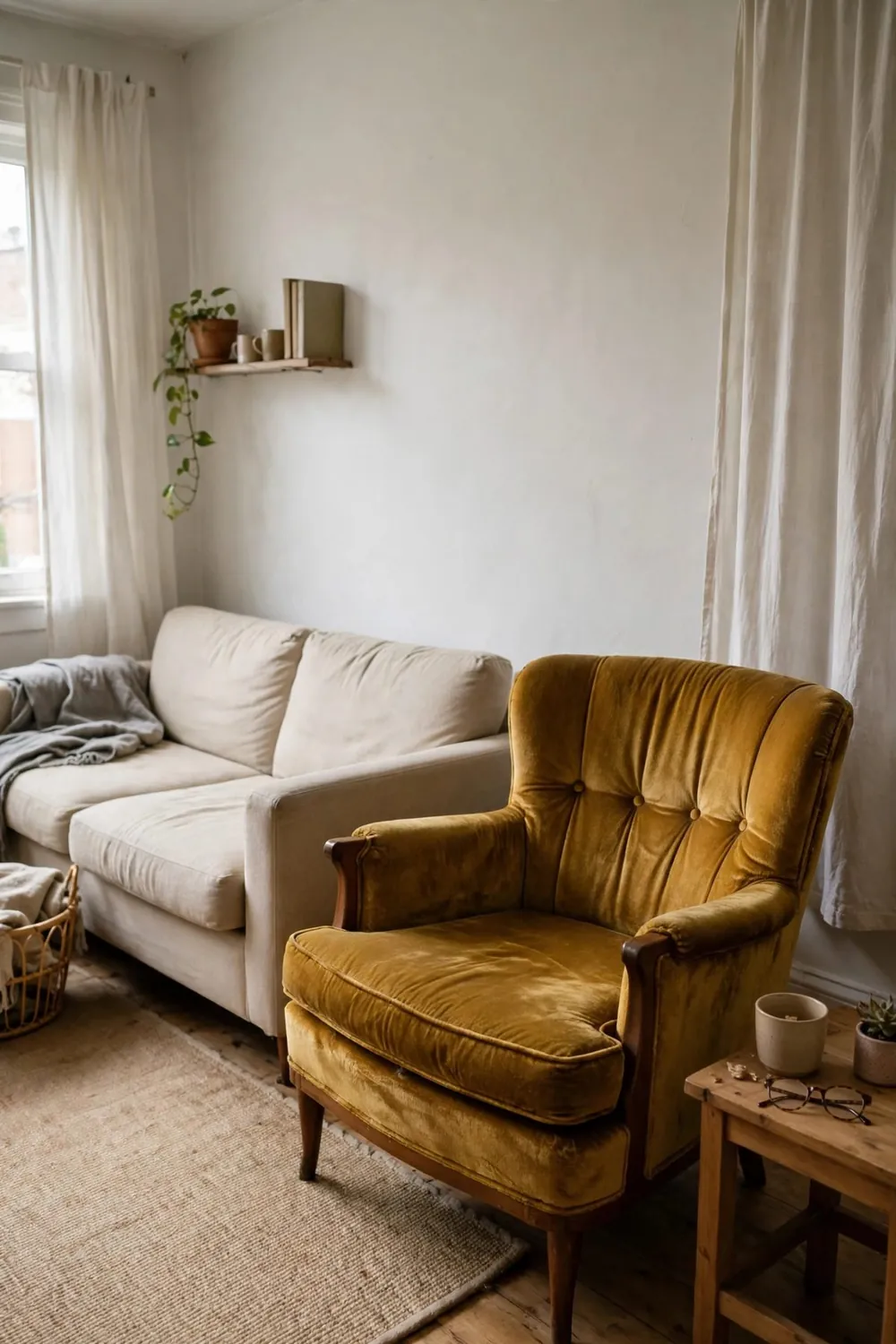
Small rooms feel chaotic when every piece of furniture is shouting. Pick one hero — a beautiful sofa, a vintage armchair, a bold rug — and let everything else be simple and supportive.
This is also a money saver. One really good piece plus simple basics looks far more expensive than six medium pieces competing for attention.
3. Use a Round Coffee Table
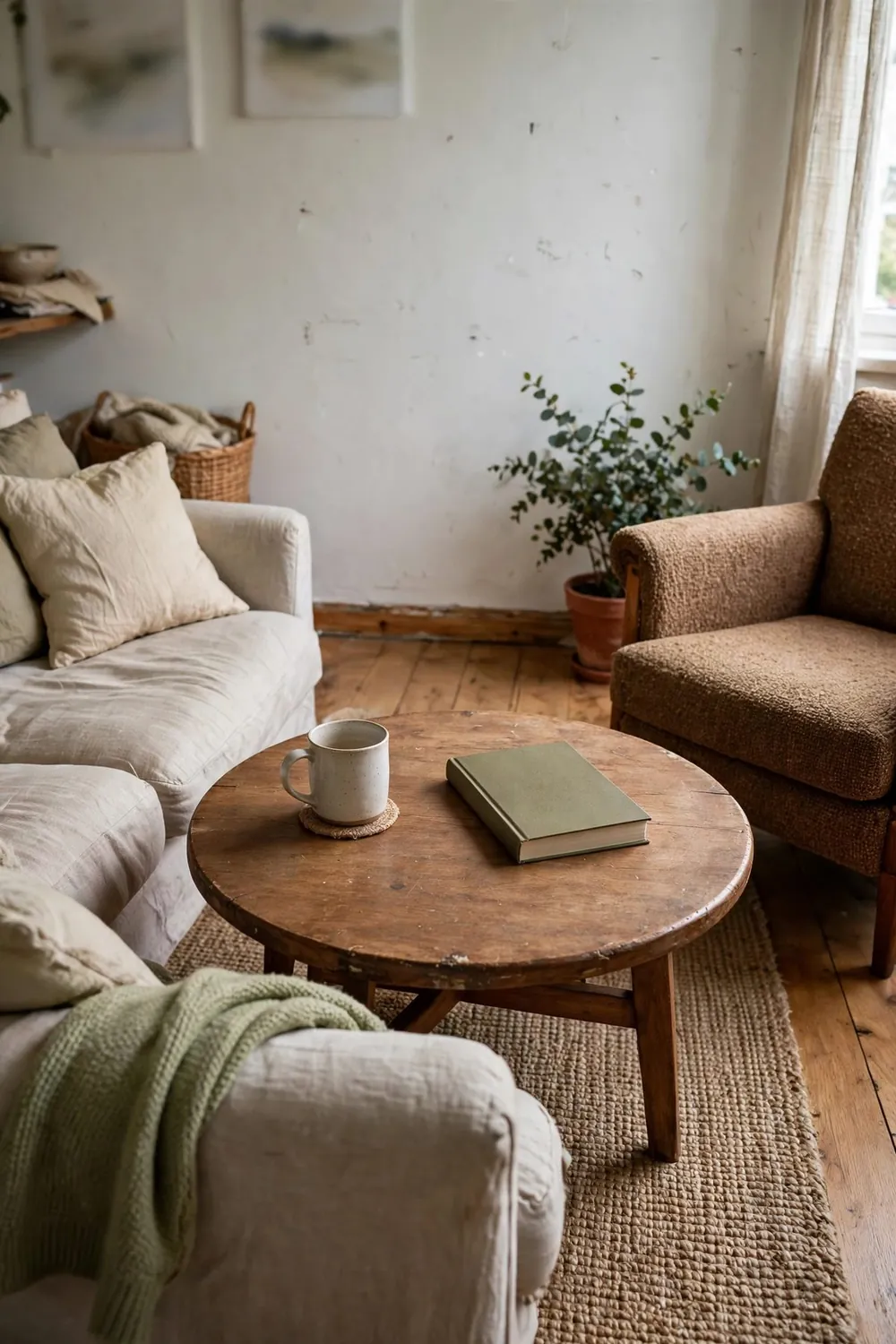
Corners eat space visually and physically. A round coffee table keeps traffic flowing around it, removes the sharp angles your shins keep finding, and softens a room full of rectangular furniture.
Round tables also seat-flexible: extra guests can perch anywhere around them, which matters when your living room is also your everything room.
4. Give Every Seat a Surface Within Reach
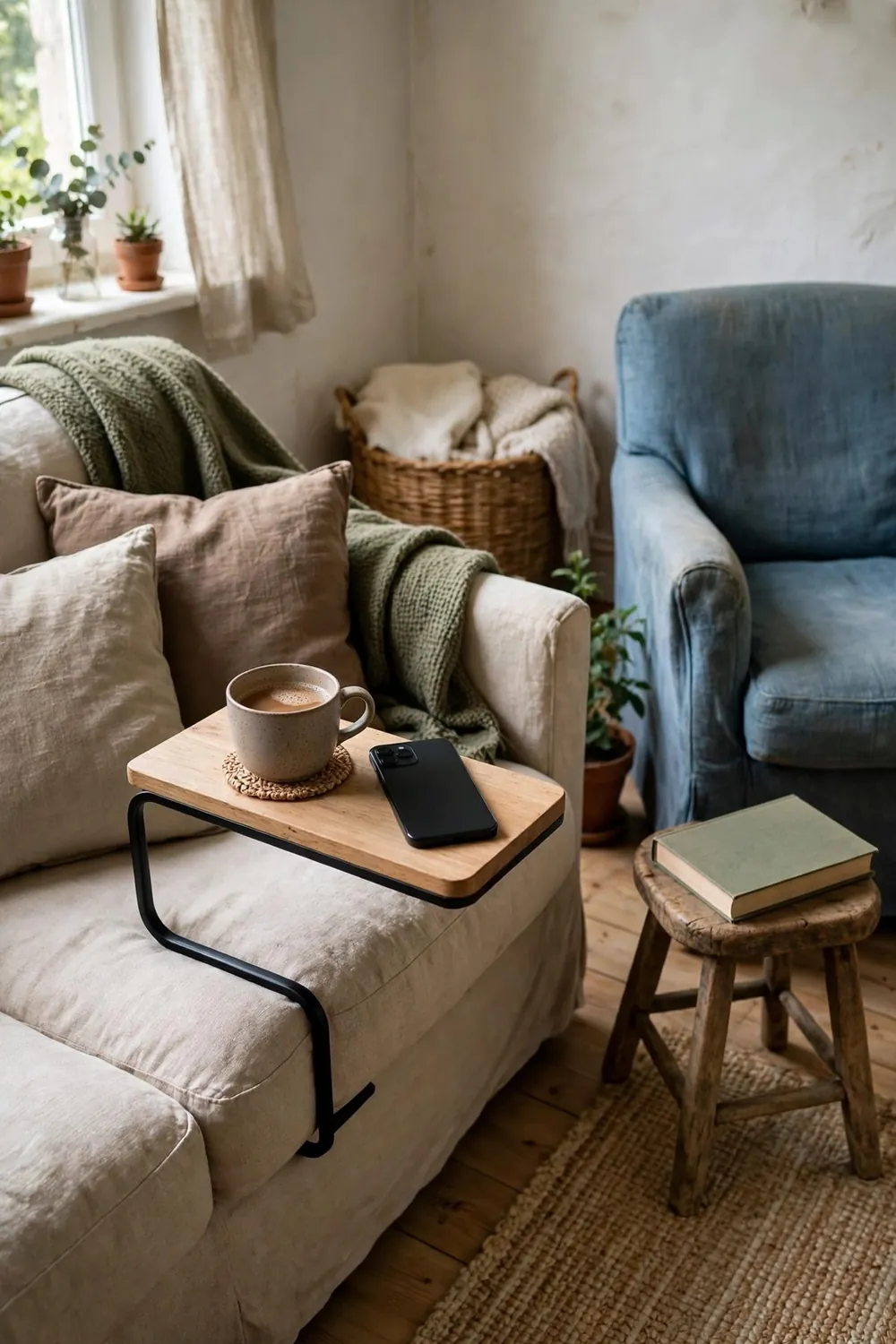
In a small room there may be no space for side tables at both ends of the sofa. Solve it with a slim C-table that slides over the sofa arm, a small stool, or a wall-mounted fold-down shelf. When every seat has somewhere to put a cup, the room works, and a room that works feels bigger than one that doesn’t.
5. Anchor the Seating With One Right-Sized Rug
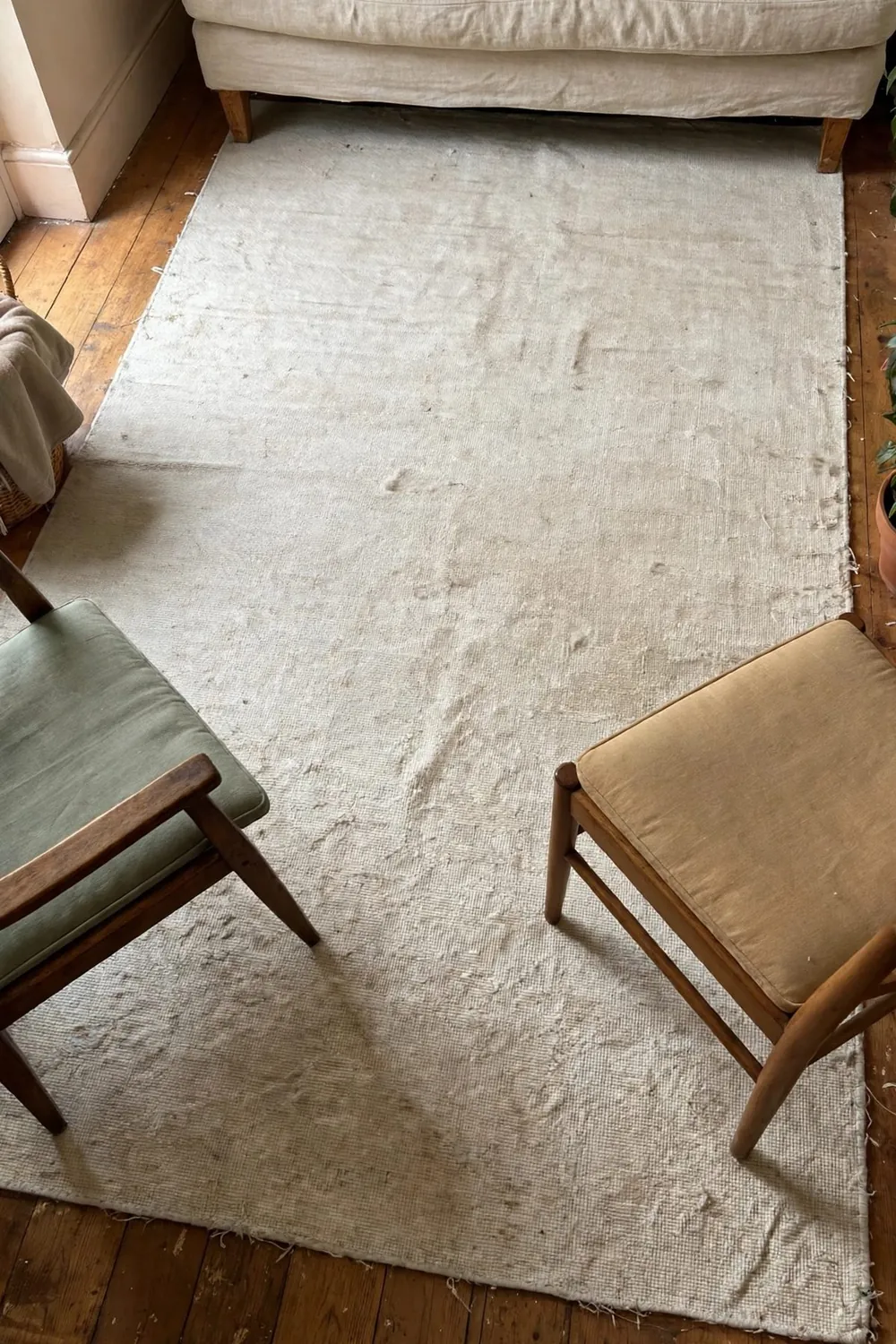
A too-small rug makes a small room look smaller — it chops the floor into pieces. Choose a rug big enough for at least the front legs of the sofa and chairs to sit on. One large, calm floor surface reads as one generous room.
Light, low-pile rugs are the small-room friendly choice: they brighten the floor and don’t fight with your furniture for attention.
Color & Light Tricks That Open the Room Up
Once the layout works, color and light do the heavy lifting. Small rooms live or die by how light moves through them.
6. Paint Walls and Trim the Same Soft Color
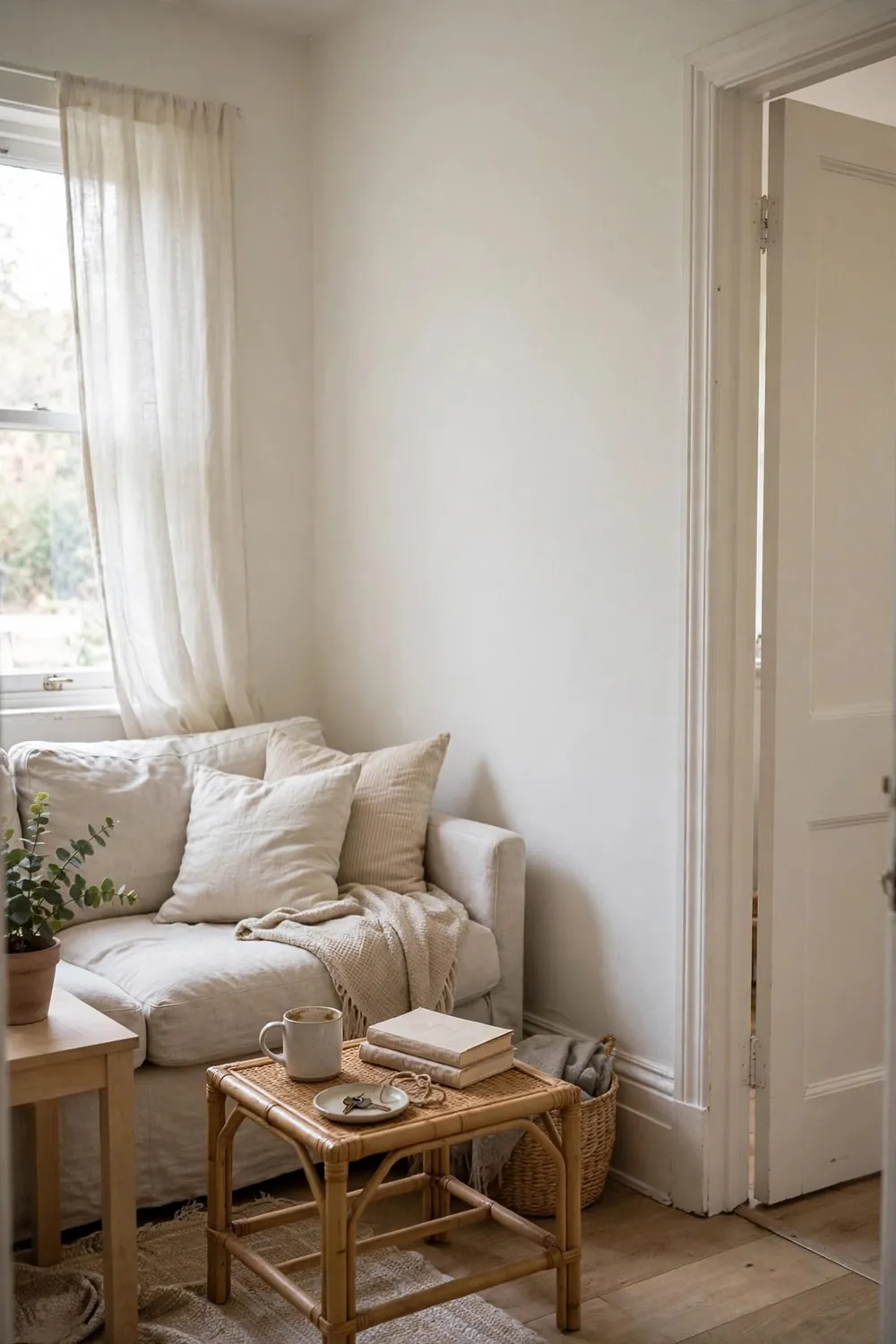
When walls, skirting, and trim share one soft color, the edges of the room blur and the eye stops noticing where the wall ends. That seamless look is worth several visual inches. Warm white, pale greige, and soft sage are the small-room champions.
Keep the ceiling a clean bright white to lift it. In a small room, a “fifth wall” painted lighter always makes the space feel taller.
7. Hang One Large Mirror Where It Catches Light
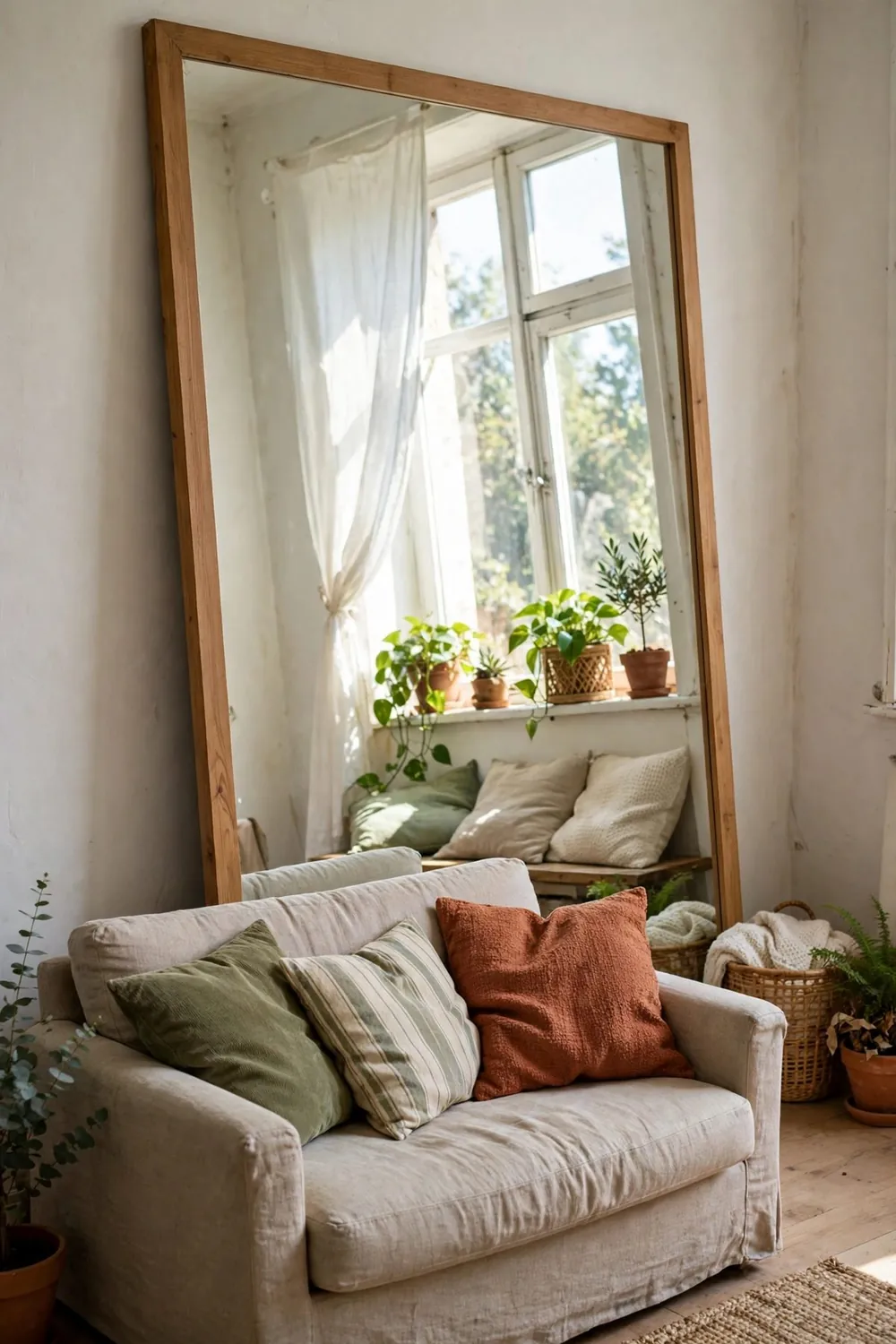
A mirror across from or beside a window doubles your daylight and gives the room a second “view.” Go bigger than you think — a large mirror works like a piece of art and a window at the same time.
No good wall? Lean a tall mirror behind the sofa or on a mantel. Leaning looks relaxed and renter-friendly, and tall shapes draw the eye upward.
8. Swap Heavy Curtains for Light, High-Hung Ones
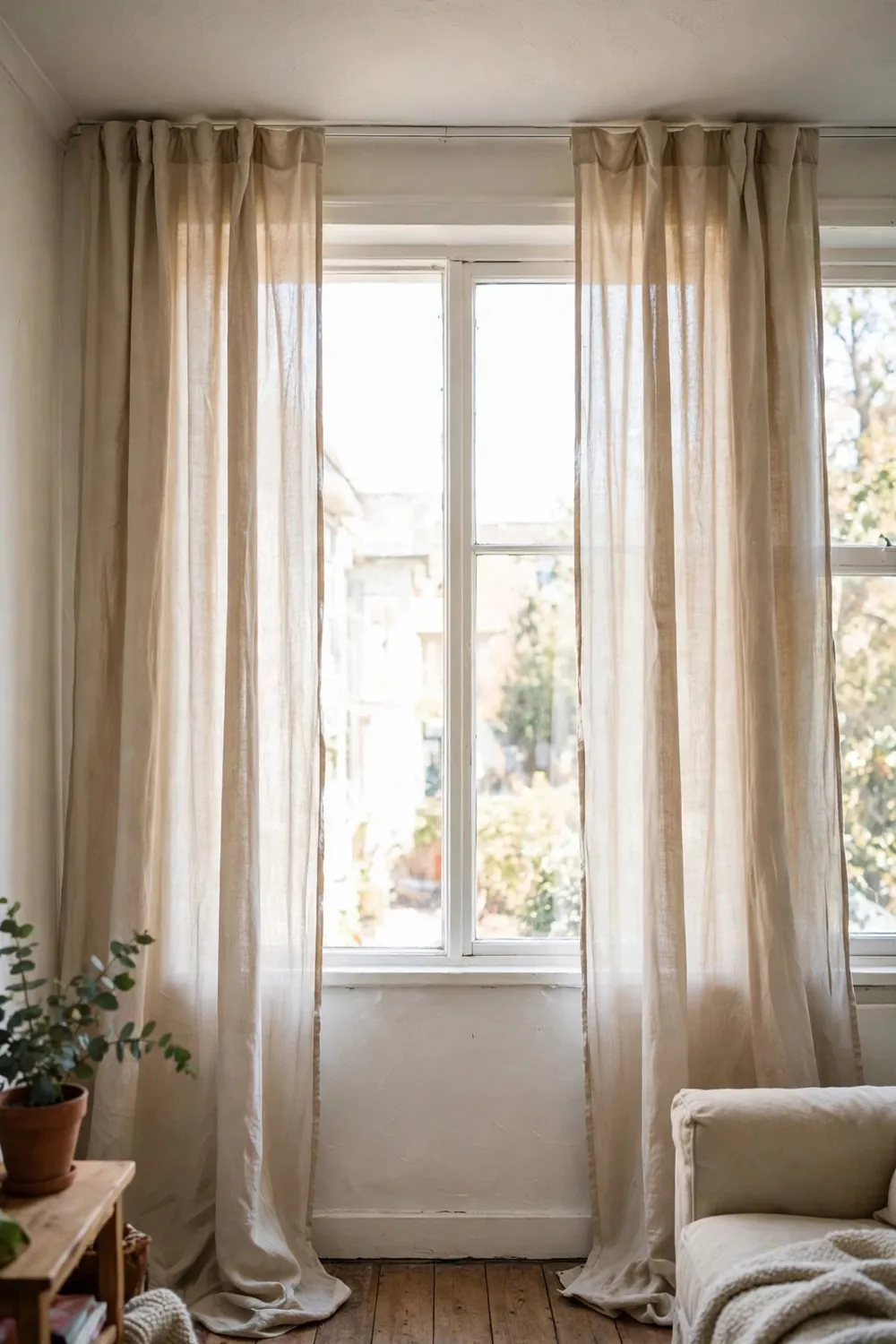
Hang curtains as high and wide as you can — rod near the ceiling, panels falling just outside the window frame. The window looks bigger, the ceiling looks higher, and the actual glass is never covered, so all the daylight gets in.
Choose light, airy fabrics in a color close to the wall so they blend rather than block. Save bold curtains for bigger rooms.
9. Layer Three Kinds of Light
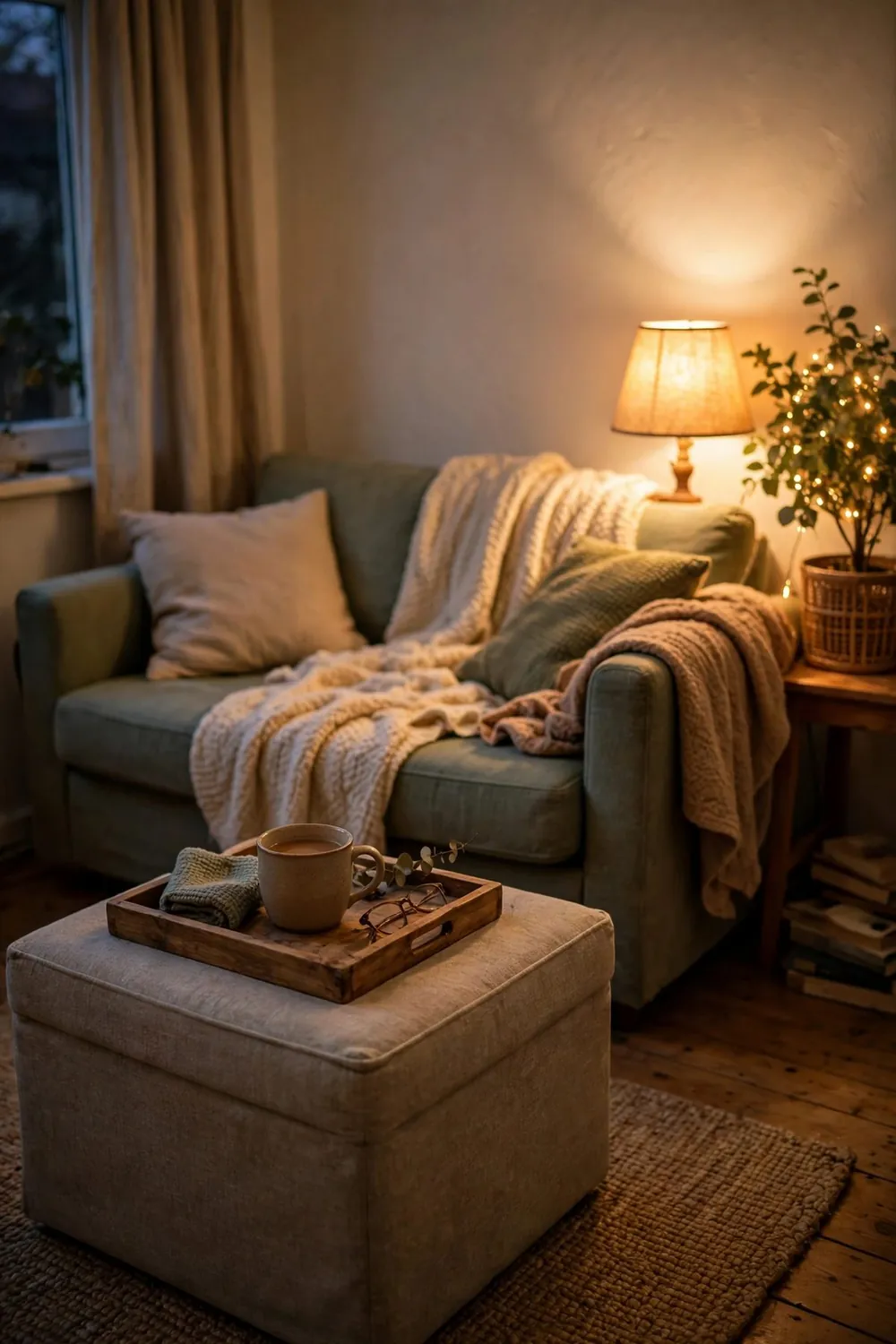
One ceiling light flattens a small room. Layer instead: something overhead for general light, a floor or table lamp for warm mid-level glow, and a small accent — a candle, a picture light, fairy lights in a plant. Three heights of light make a room feel deep and cozy instead of small and flat.
In the evening, turn the overhead off entirely. Lamp-height light is the coziest trick in this whole article.
10. Keep the Palette Tight: Two Colors Plus Wood
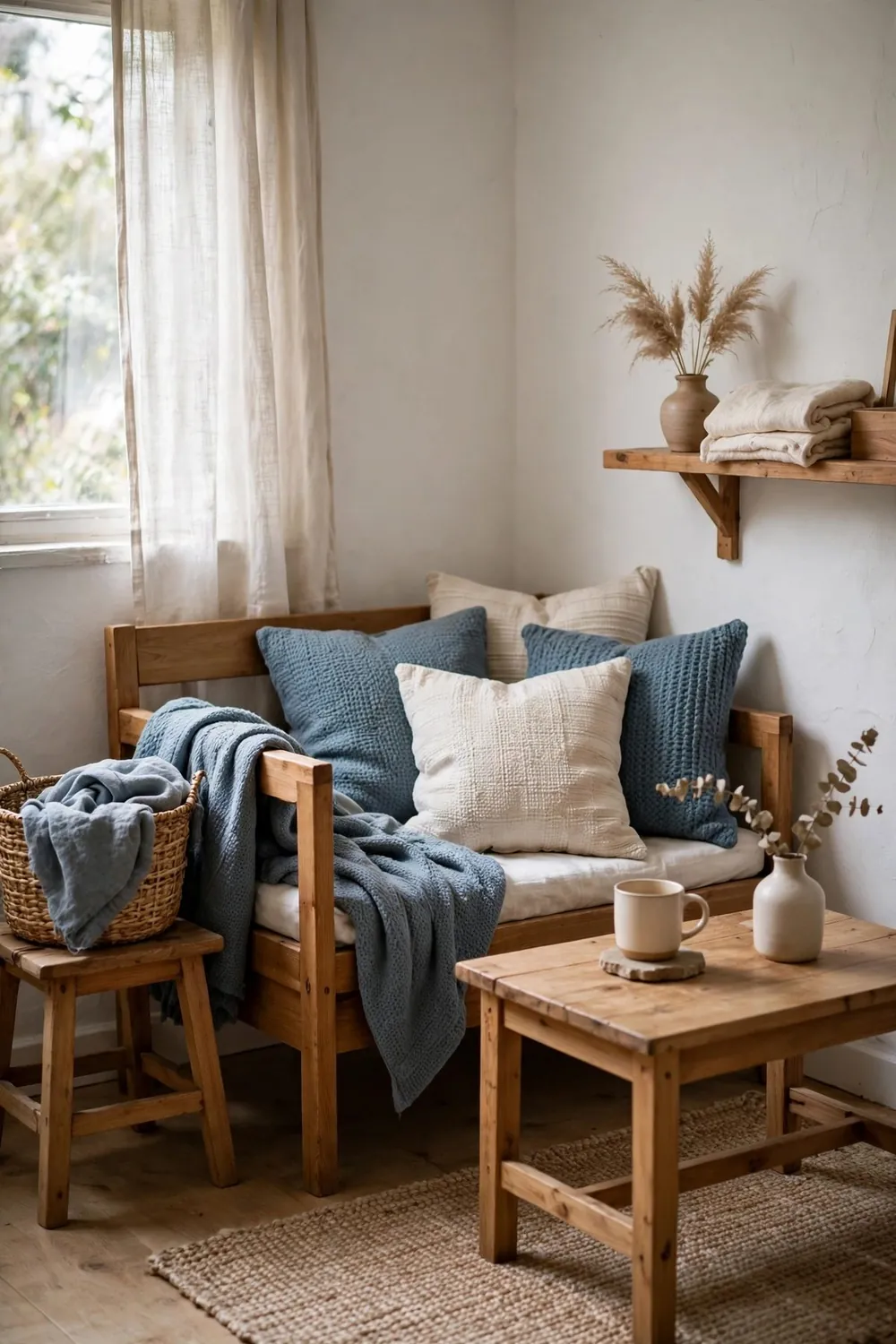
A small room with ten colors feels busy; a small room with two main colors plus natural wood feels designed. Pick your pair — say, warm white and sage, or cream and dusty blue — and let cushions, throws, and art play inside it.
This does not mean boring. Texture is where you add richness: linen, boucle, rattan, wool, and wood grain all count as interest without adding visual noise.
Storage & Styling That Keeps It Calm
The final stretch is about the things that make small rooms fail: clutter and dead corners. These ideas turn both into features.
11. Go Vertical With Tall, Slim Shelving
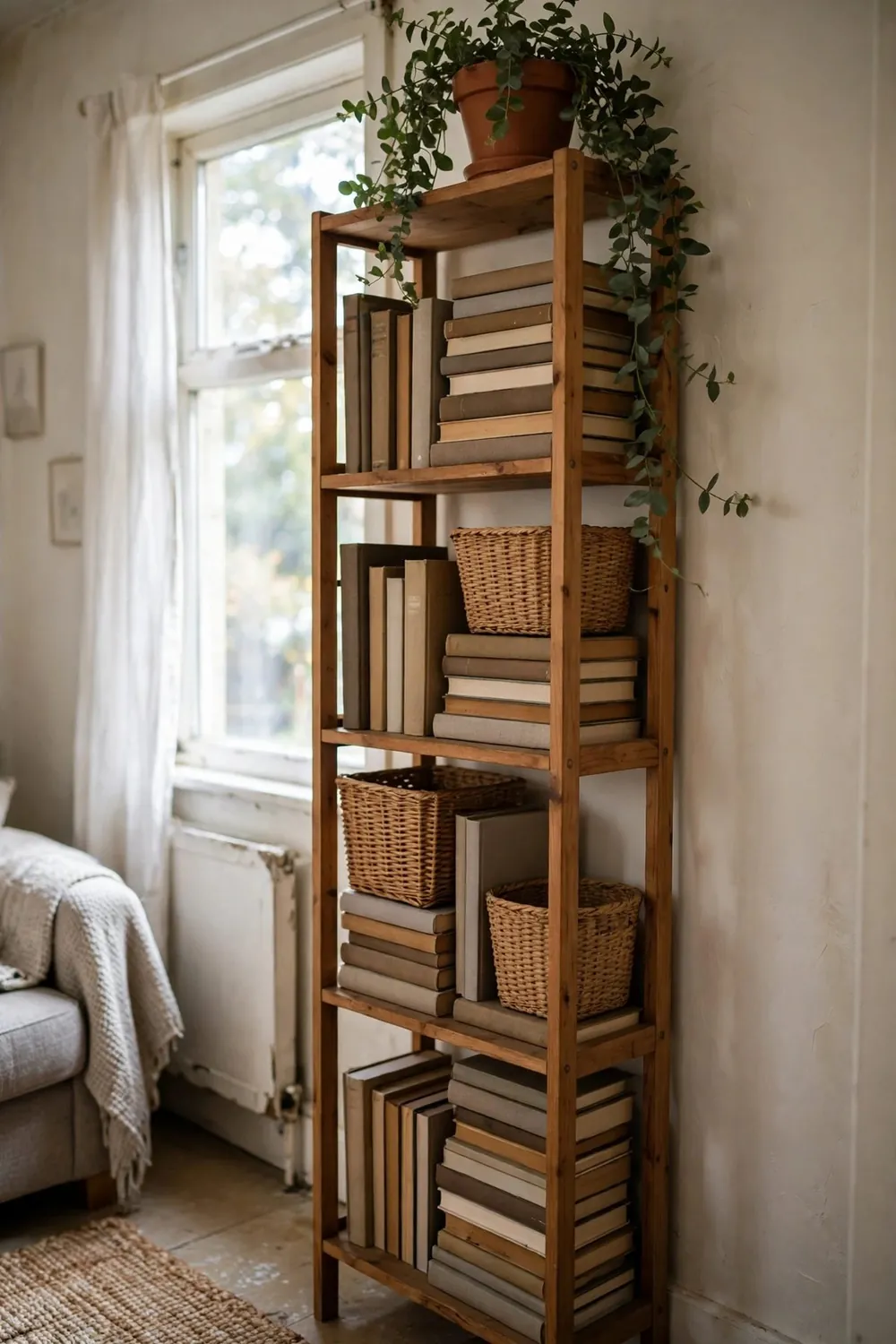
Floor space is precious; wall height is free. One tall, narrow bookcase stores as much as a wide low one while taking half the footprint. Style it with books, a few baskets down low for the messy things, and breathing room up top.
Leave some shelves partly empty. In a small room, negative space is a styling choice, not a waste.
12. Choose Furniture That Hides Things
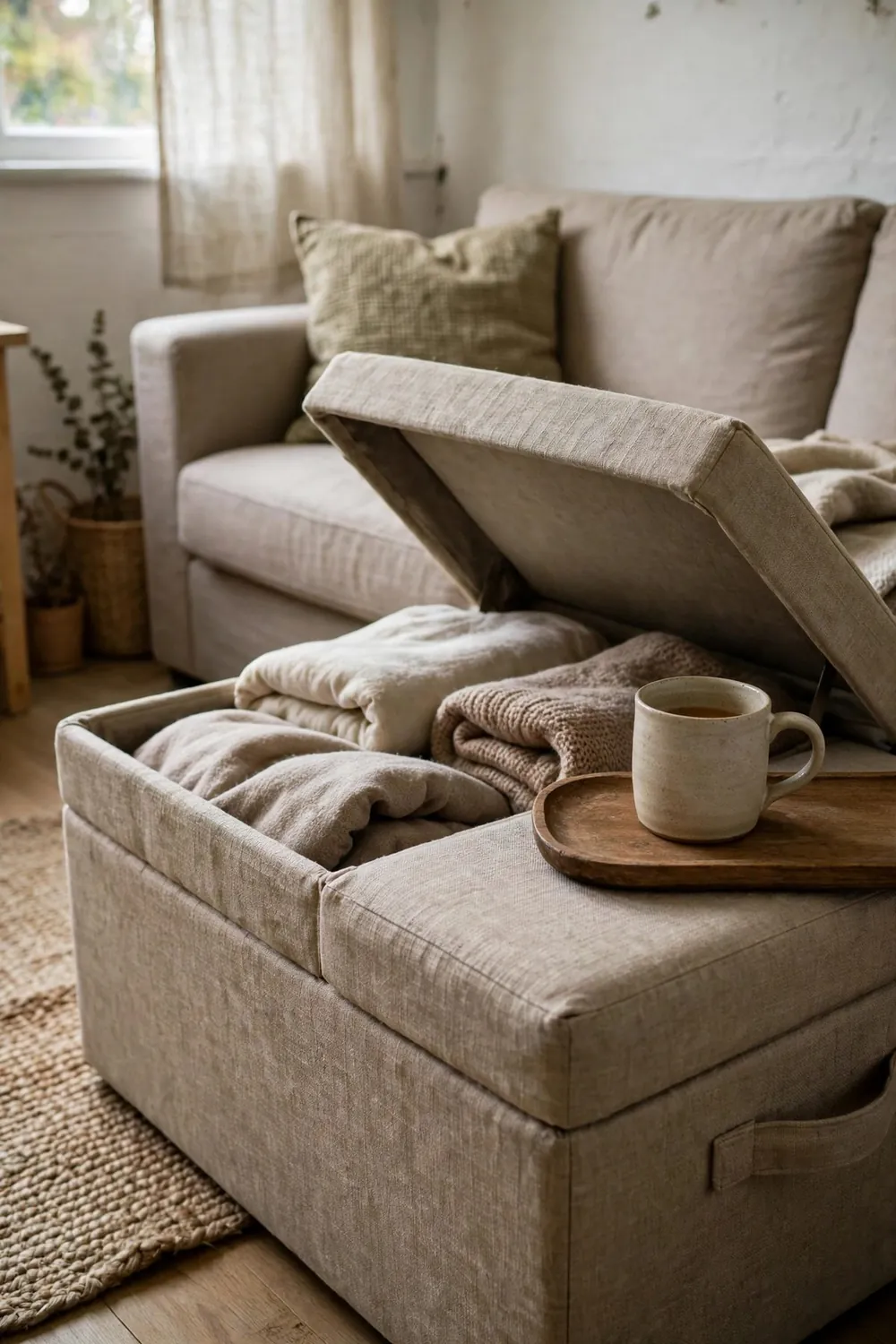
An ottoman that opens, a coffee table with a shelf, a sofa with storage under the seat — in a small living room, every piece should ideally do two jobs. Hidden storage is what lets you keep the visible surfaces calm.
Start with the ottoman: it is a footrest, extra seat, tray table, and blanket cupboard in one soft cube.
13. Use Baskets as Your Overflow System
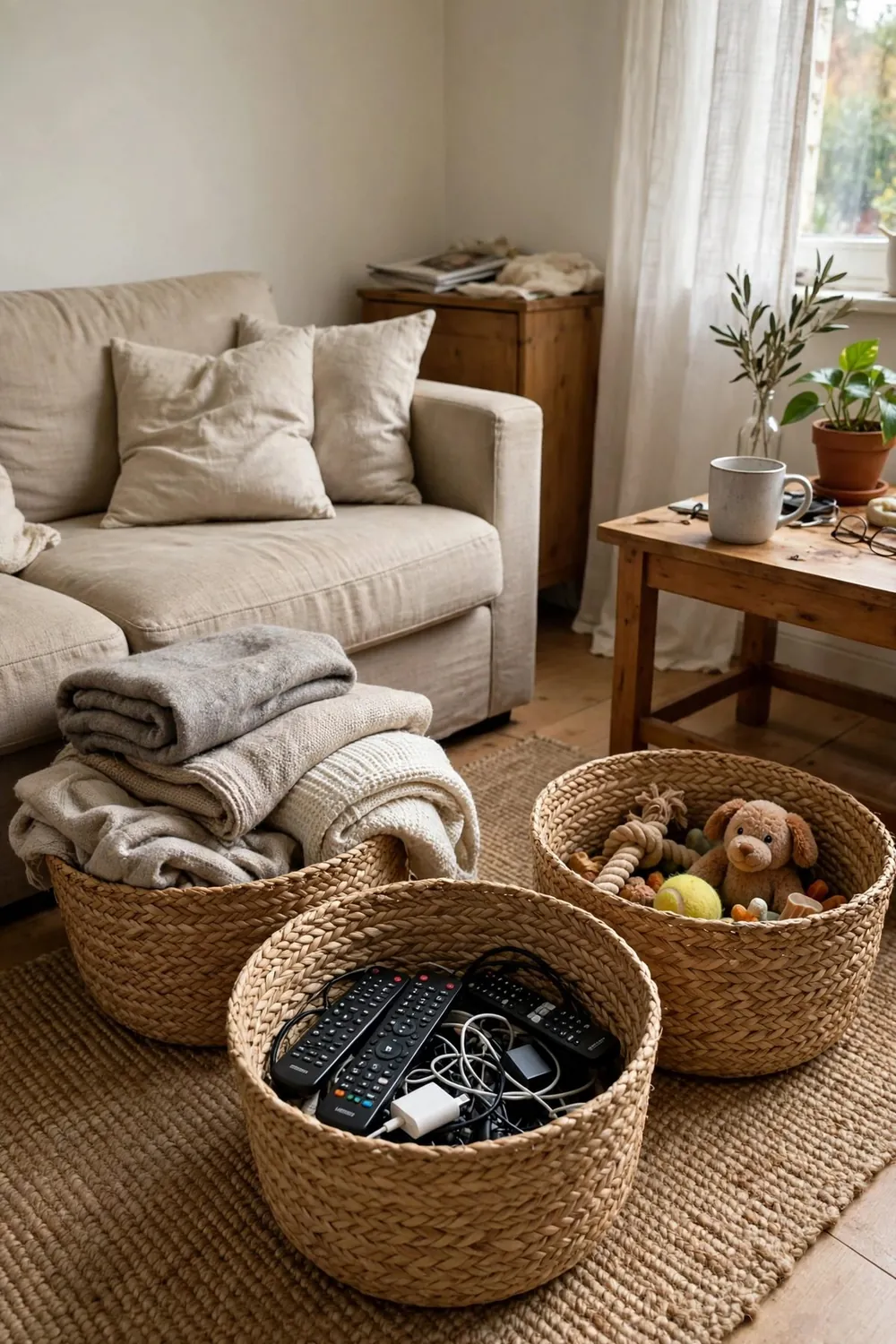
Woven baskets are the small-room pressure valve. One for throws, one for remotes and chargers, one for the kids’ or dog’s things that migrate. When everything has a basket, tidying takes ninety seconds — and a tidy small room feels twice the size of the same room messy.
Keep baskets in one material family (all seagrass, all rattan) so the system looks like decor, not storage panic.
14. Make One Corner Do Something Delightful
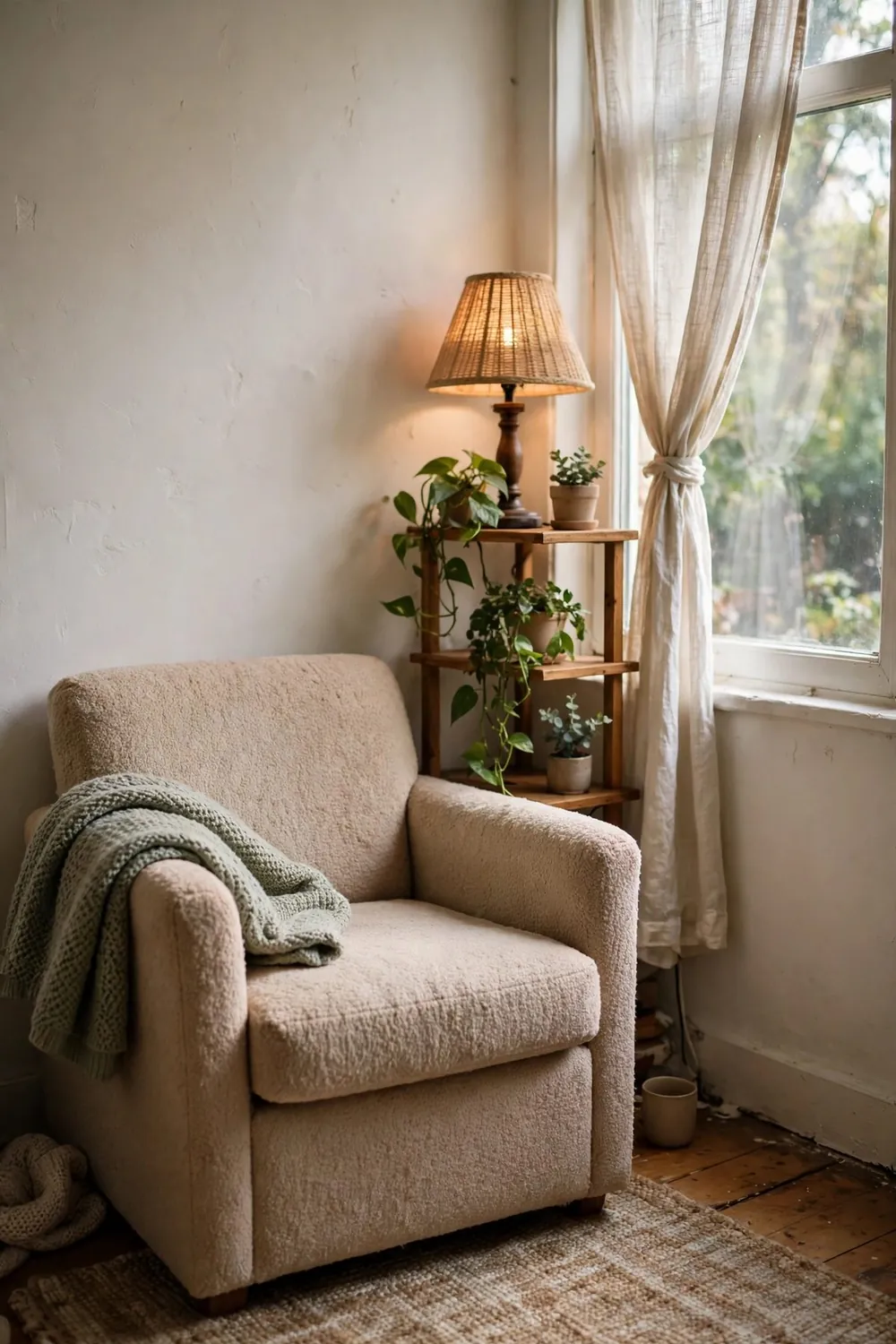
A small room feels generous when it has a moment of pure pleasure in it: a reading corner with a chair and lamp, a tiny plant shelf jungle, a record player on a stool. Delight is what people remember — not square footage.
That corner also gives a small room a “destination,” which makes the whole space feel like it has rooms within it rather than one box of furniture.
15. Edit Ruthlessly, Then Edit Again
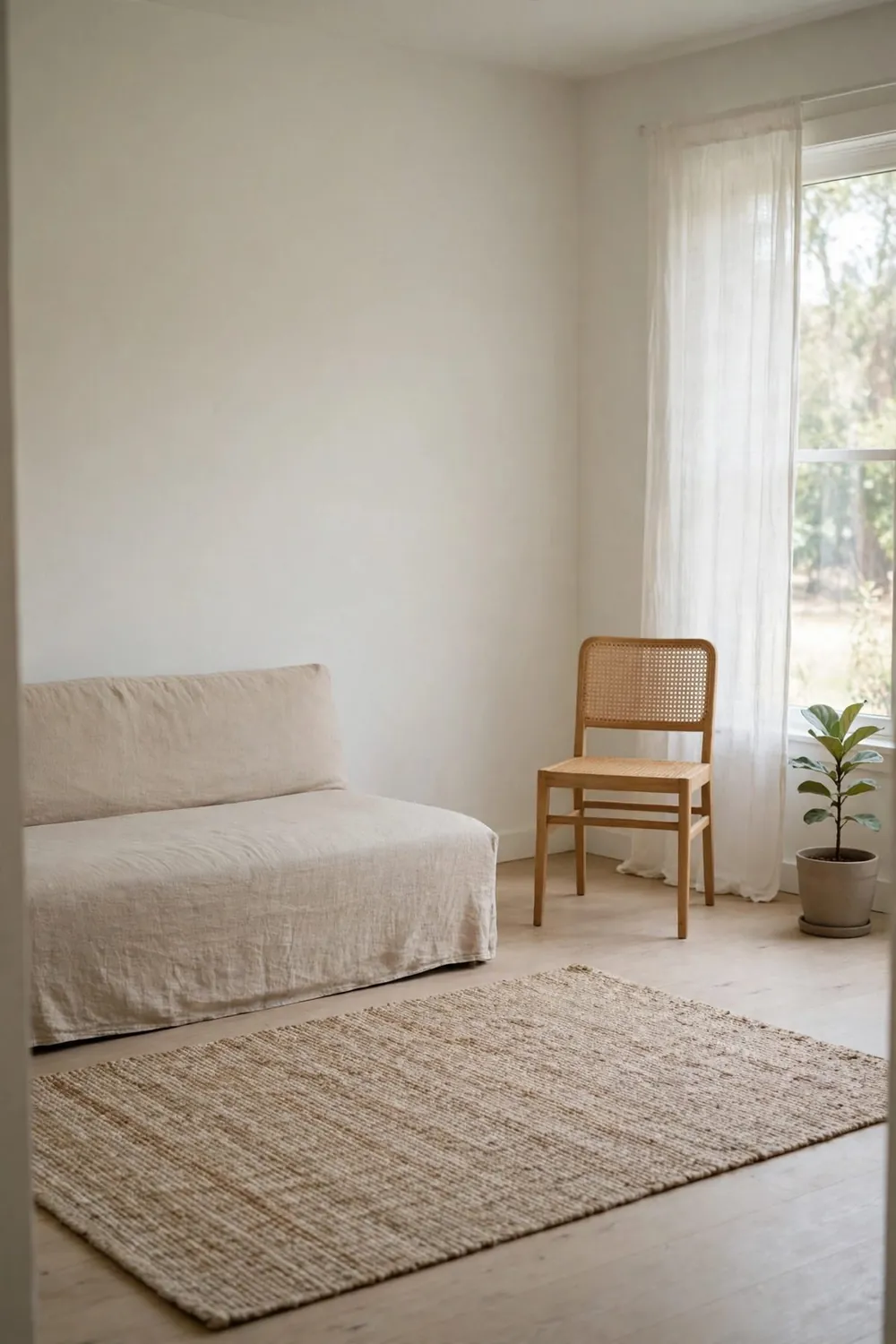
The hardest and most powerful small-room skill is subtraction. Keep only what you use weekly or truly love looking at. The rest — the third vase, the chair nobody sits in, the pile of someday projects — is quietly stealing your space.
Try the box test: put doubtful items in a box for a month. If you never reach for them, your room has told you something.
More Small-Room Ideas That Earn Their Space
Still collecting ideas? These final additions round out the list — each one tested against the same rule as everything above: it has to earn its place in a real home, on a real budget.
16. Use Nesting Tables Instead of One Big Side Table
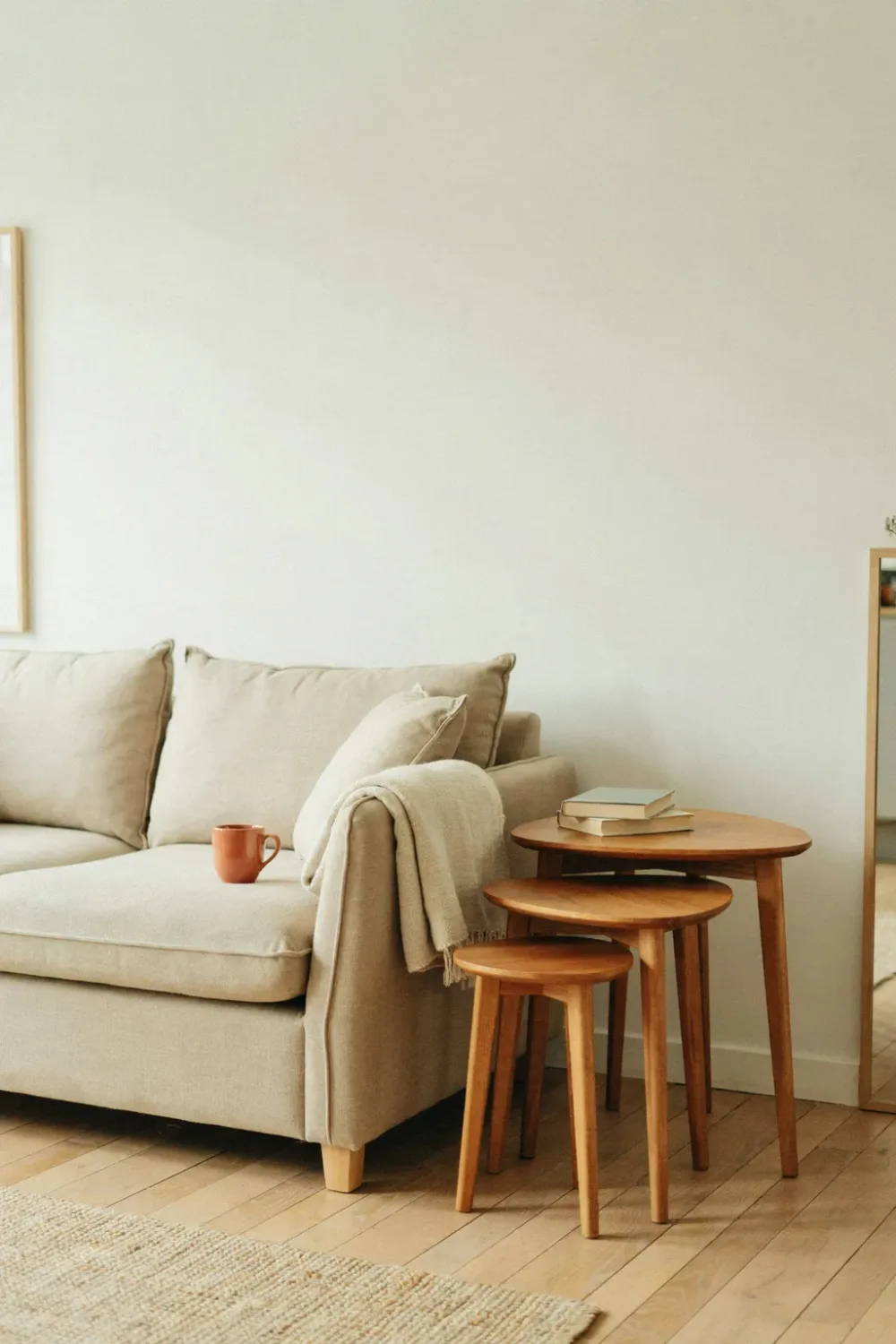
A pair of nesting tables gives you surface when guests come and floor space the rest of the week — slide the small one under the large one and the room breathes again. Choose slim legs and a light finish so they read as airy, not bulky.
They are also the renter’s best friend: no fixing, no measuring, and they move to a new apartment without drama. Thrifted sets are common and a coat of paint unifies any mismatched pair.
17. Hang Curtains at Ceiling Height
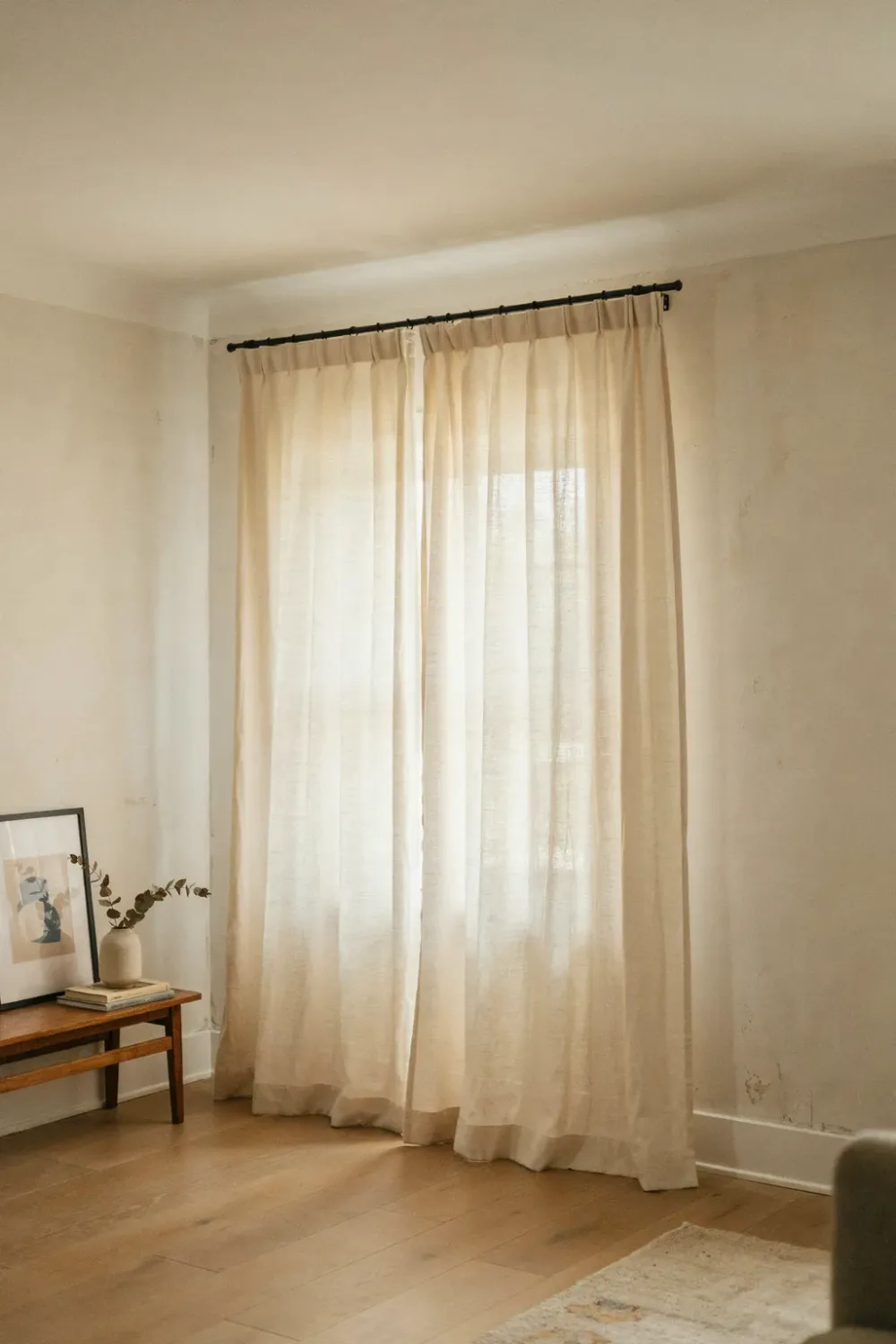
Mounting the curtain rod just below the ceiling — and letting the curtains fall to the floor — draws the eye up and makes walls feel a full foot taller. It is the oldest small-room trick there is, and it works even when the window itself is modest.
Keep the fabric light in color and weight: heavy dark drapes at ceiling height close a small room in, while pale linen-look panels lift it. Extend the rod 15 cm past the frame each side so the panels stack on wall, not glass.
18. Choose a Low-Back Sofa
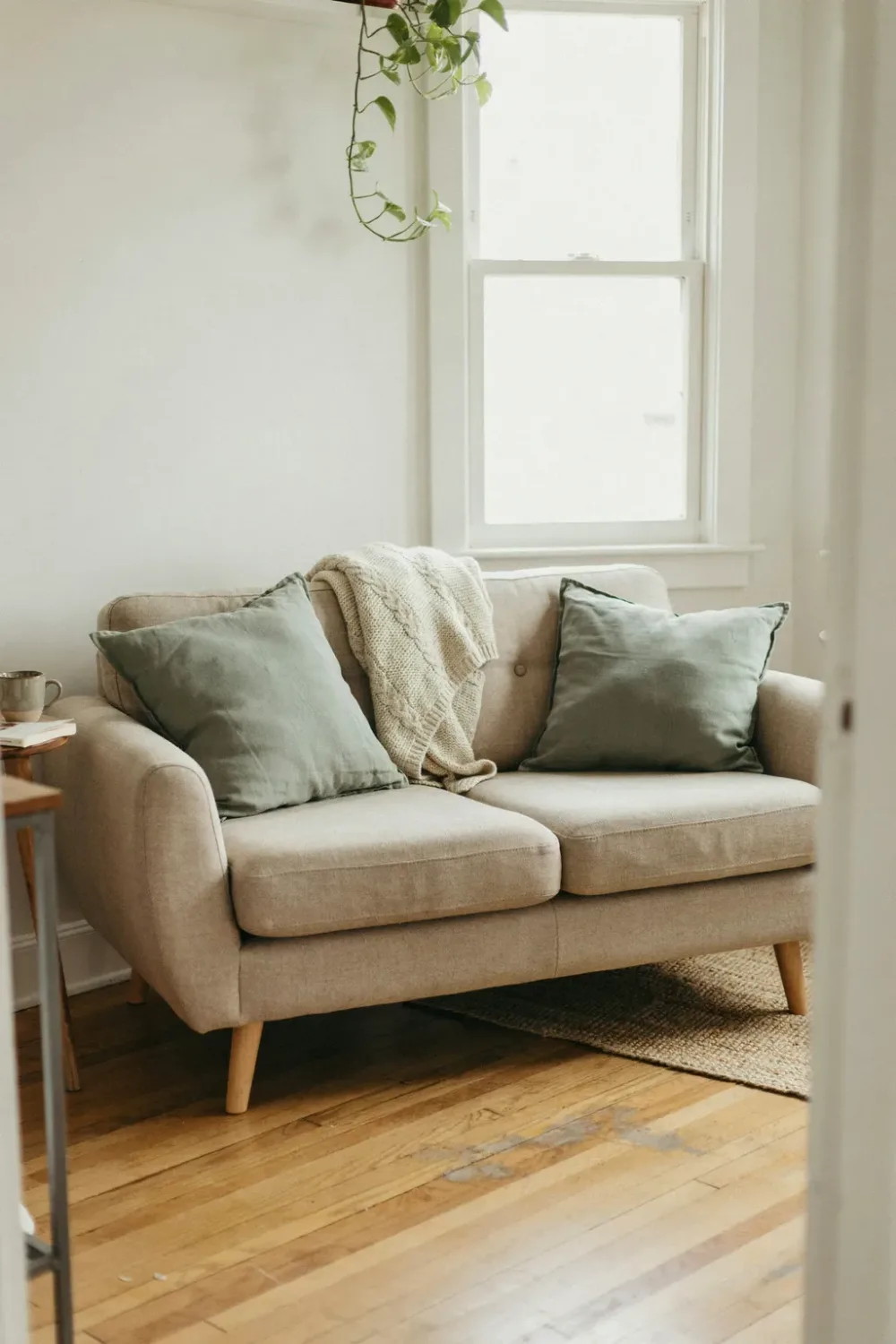
In a small room, the sofa’s back height decides how much wall and light you keep. A low back (under 85 cm) preserves sightlines across the room, lets window light travel, and makes the ceiling feel higher. Pair it with good lumbar cushions so comfort does not suffer.
Test before you buy: sit, and check your shoulder blades are supported. Low-back sofas suit loungers less than upright sitters, so be honest about how you actually use the room.
19. Add a Slim Console Behind the Sofa
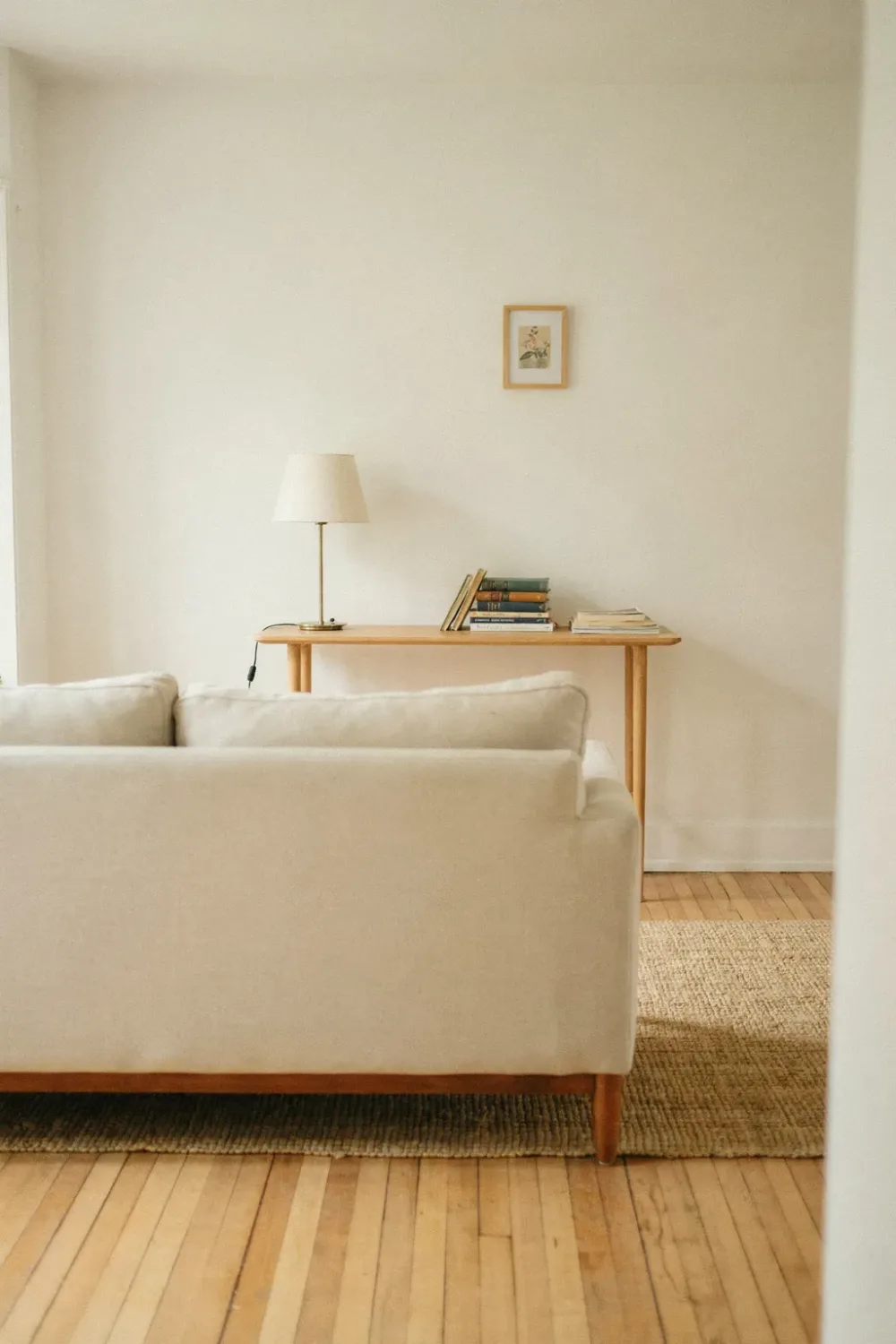
Floating the sofa even 20 cm off the wall makes room for a narrow console — a hidden home for remotes, coasters, a lamp, and the charging cables that otherwise colonize the coffee table. In a small room, storage that hides in plain sight is worth more than any ornament.
A console 25–30 cm deep is enough. Add two lidded baskets underneath and you have gained a whole cupboard without losing a single seat.
20. Anchor the Zone With One Generous Rug
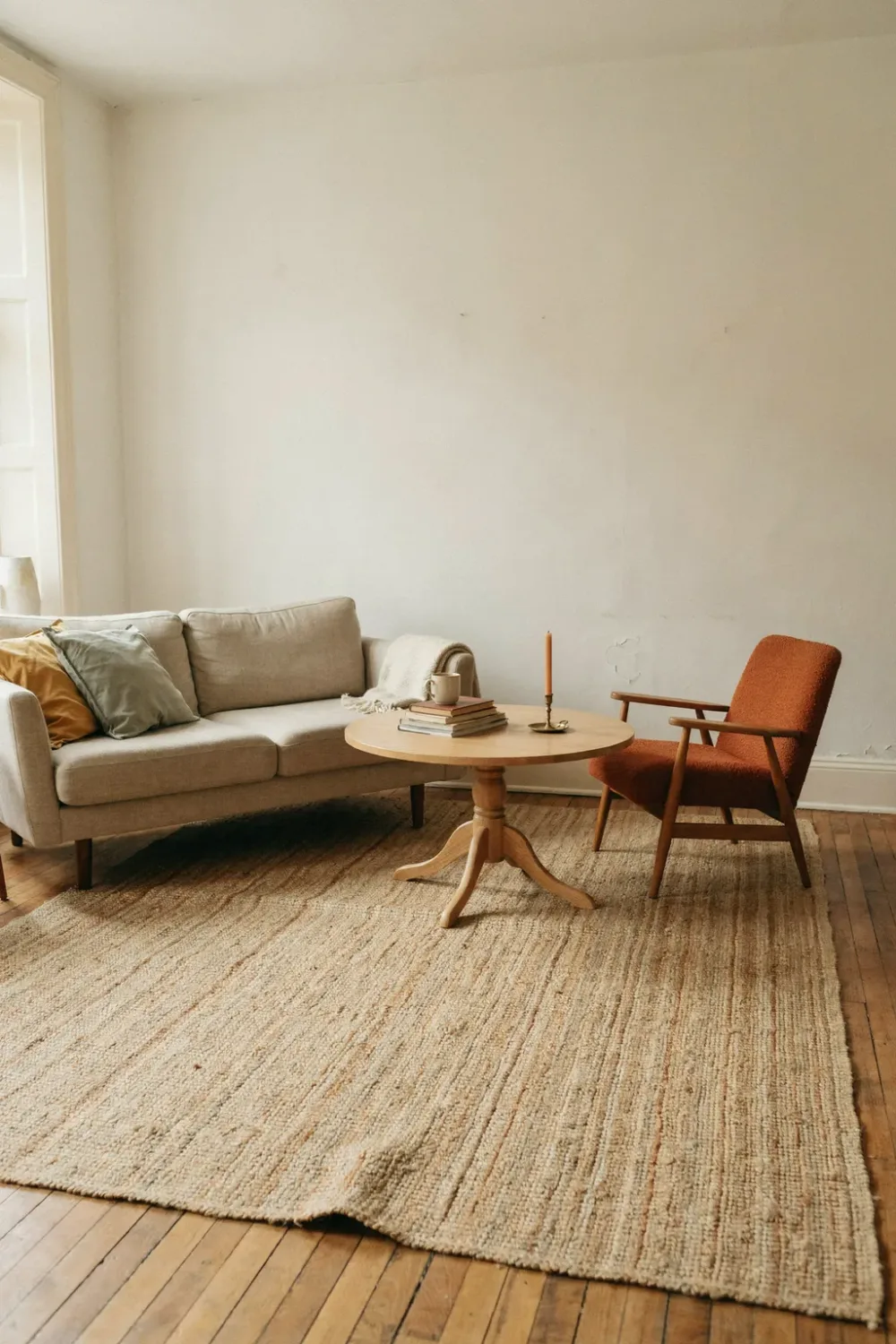
Counter-intuitively, a small rug makes a small room look smaller — it reads as an island. One generous rug that reaches under the front legs of every seat ties the group together and makes the whole zone feel planned and larger. Leave a border of floor visible at the edges.
Measure before you shop and tape the outline on the floor for a day. Flat-weave rugs keep the footprint light and are the easiest to live with in high-traffic small rooms.
21. Keep the Palette to Three Colors, Repeated
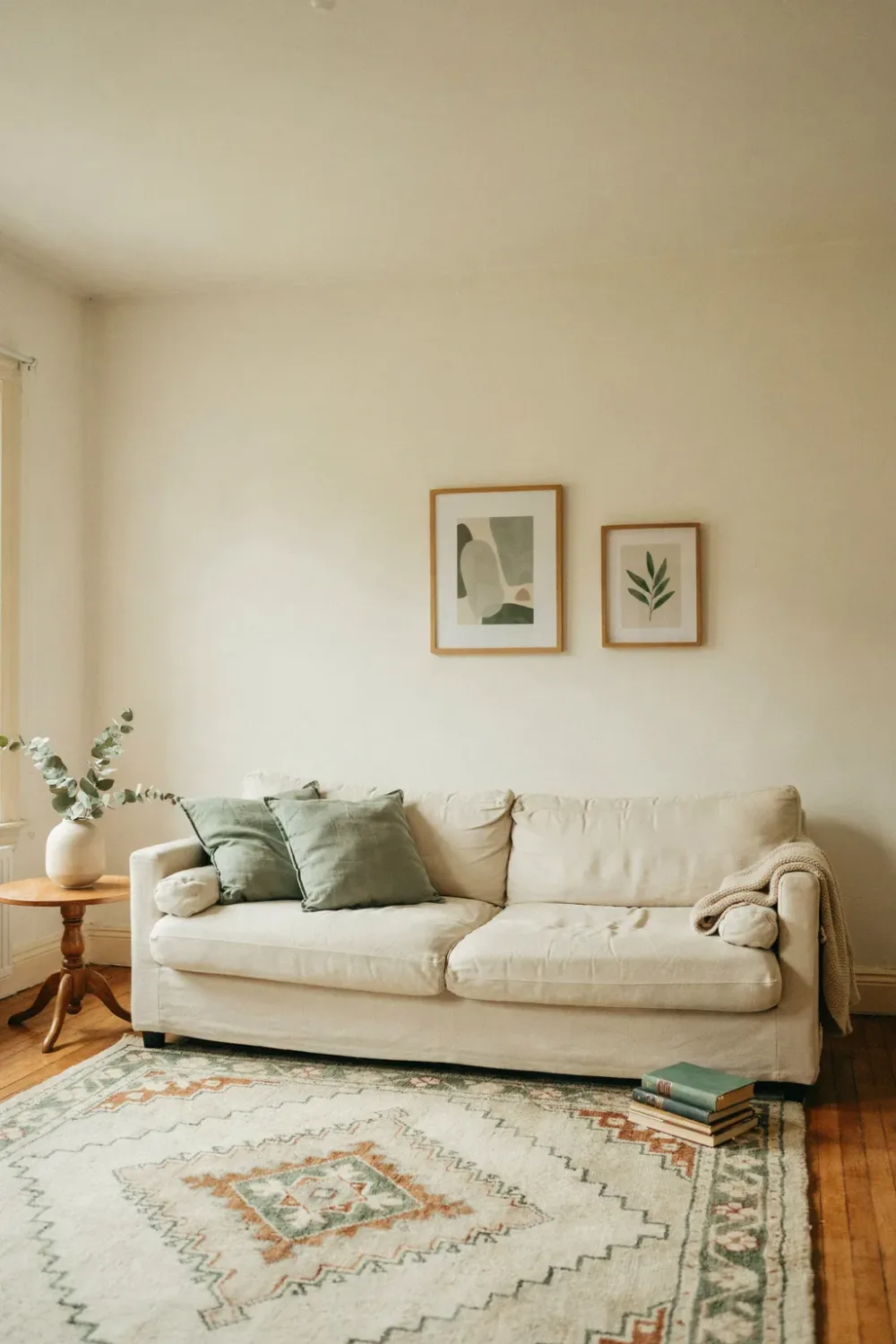
Small rooms feel bigger when the eye is not constantly restarting. Pick three colors — say warm white, oak, and one accent — and repeat each at least three times around the room. The repetition reads as calm and spacious; five competing colors read as clutter even in a tidy room.
This is also a money-saver: a tight palette stops impulse buys, because anything outside the three simply does not come home with you.
22. Draw the Eye Up With One Tall Plant
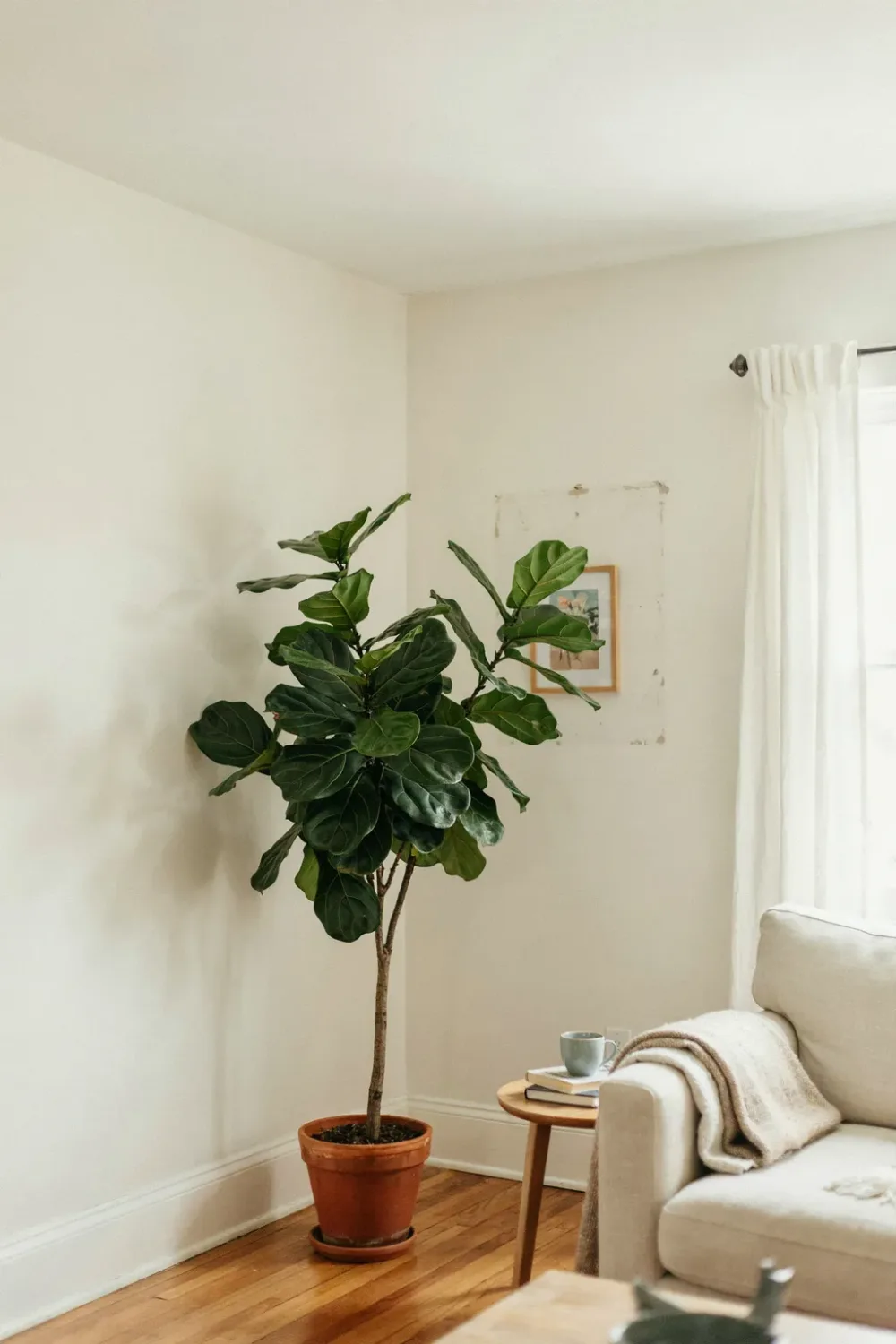
A single tall plant in the corner — a fiddle-leaf, olive tree, or tall snake plant — pulls the eye upward and reminds visitors the room has height, not just floor area. Height is the dimension small rooms hide best, so use it.
Real or high-quality faux both work; what matters is scale. A plant that stops at table height underlines the room’s smallness, while one that reaches toward the ceiling stretches it.
Small Living Rooms for Real Life
The principles flex for the ways small rooms actually get used.
The small room with a TV. Mount the TV at seated eye height, float it on the shared wall with the room’s other functions, and let a slim console or floating shelf below hide the boxes. Arrange seating for both conversation and viewing by putting chairs at slight angles rather than in a cinema row. Dark screens read as black rectangles — a gallery arrangement around the TV, or the wall painted a shade deeper behind it, helps it sit quietly in the room when it is off, which is most of the day.
The small room with kids or pets. Choose the forgiving versions of everything: washable cushion covers, a rug that hides a multitude (a low-pile pattern in mid tones is camouflage you can walk on), baskets with lids for the toy rotation, and a storage ottoman that swallows the evening’s debris in one lift. Keep one beautiful, breakable thing up high — a plant on the tall shelf — so the room still feels like yours. Small family rooms that work are not precious; they are edited.
The studio: living room, bedroom, office, one room. Zones are your architecture: a rug for the living zone, the bed made beautifully as the room’s second “sofa,” the desk given its own small rug or mat and its own lamp. Light creates the rooms at night — the living zone glows warm while the bed zone rests darker. Storage must be ruthless and vertical. Studios decorated this way stop feeling like one room doing impressions and start feeling like a small, clever home.
The Vertical Half of the Room
Small-room advice obsesses over the floor plan and forgets that half the room is above eye level. Here is how to use the vertical half well.
Hang art at sitting height, and hang it as one composition. In living rooms we view art seated, so the gallery rule of “center at standing eye level” puts everything too high. Aim for the center of your arrangement around 48 inches from the floor in a seating room, and treat a group of frames as one big piece with one outline. One generous composition beats five small frames scattered like punctuation.
Use the wall above the sofa fully. That wall is the small room’s billboard — a large mirror (Idea 7), one big piece of art, or a pair of floating shelves with a plant and three objects. What it should not be is empty with one tiny frame floating in the middle, which makes both the wall and the room feel smaller and slightly sad.
Curtains to the ceiling, shelves to near it. Every vertical line you extend raises the room’s perceived height. The tall slim bookcase from Idea 11 works because it nearly touches the ceiling; a short wide one of the same volume feels squatter. When buying any tall piece for a small room, the question is always “can it go taller and narrower?”
Keep the top of the room light. Ceiling bright white, the tops of shelves styled with airy things (a trailing plant, pale ceramics), heavy dark objects stored low. Eyes read a room’s weight distribution instantly: light above and grounded below feels spacious; the reverse feels like a lid.
How to Recreate These Ideas in the Right Order
Step 1 — Layout first (free). Float the sofa, swap in a round table if you can, and check that every seat has a surface. Live with it for a few days before buying anything.
Step 2 — Rug and mirror. Measure for the biggest rug the seating area can take, and hang one large mirror where it will catch window light. These two purchases change the room’s apparent size the most.
Step 3 — Color tune-up. If you can paint, do walls and trim in one soft color. If you rent, match your large textiles — curtains, rug, sofa throw — to one tight palette of two colors plus wood.
Step 4 — Light layers. Add one lamp at sofa height and one small glow source. Turn the overhead light off in the evening and notice how the room grows.
Step 5 — Storage sweep. One storage ottoman, one tall slim shelf, two or three baskets. Then do the ruthless edit and enjoy the space that was hiding underneath.
Going deeper: the painter’s-tape rehearsal. Before any furniture moves or money moves, tape the proposed layout on the floor at full scale — sofa outline, chair, table, and the walking paths between them, which need a honest 75 centimeters minimum. Live with the tape for a day: walk the paths with a laundry basket, sit where the sofa will be and check the view, open every door that swings into the room. Small rooms forgive almost nothing, and this zero-cost rehearsal catches the classic errors — the chair that blocks the radiator, the table that steals the walkway — while they are still made of tape. Photograph the taped room from the doorway, too; the plan view reveals crowding your eye excuses at floor level. Only then rearrange once, in the right order, and be done.
Real-Life Problems, Solved
These are the questions real people ask most when a room isn’t working yet, answered for this style.
There are doors and windows on every wall. How do I arrange furniture?
Pull the furniture off the walls. Float the sofa on a rug and put a slim console behind it, and the room immediately has a center. Keep walkways around 75–90 cm (30–36 in) wide between doors, and mark the layout on the floor with painter’s tape before moving anything.
Why does my room still feel unfinished even though it’s tidy?
Usually the art is too small, the curtains are hung too low, or there is only a ceiling light. Choose one larger piece instead of several tiny frames, hang curtains close to the ceiling and let them reach the floor, and add two lamps at different heights.
Budget Guide: Where to Save, Where to Spend
Save on: mirrors (large second-hand mirrors are everywhere and a coat of paint fixes any frame), baskets, curtain panels, and paint — a single soft color is the cheapest transformation in decorating.
Spend a little more on: the rug and the sofa. The rug sets the room’s size illusion and gets walked on daily; the sofa is where you actually live. In small rooms especially, these two carry the whole look, so buy the best you can manage and keep everything else simple.
Thrifted and vintage pieces are a small room’s secret weapon: older furniture was often made at a slightly smaller scale than today’s oversized pieces, so it fits beautifully.
Mistakes to Avoid
Pushing everything against the walls. It leaves a dead empty middle and makes the room feel like a waiting room. A floated, gathered arrangement feels larger and far more inviting.
A rug that’s too small. A postage-stamp rug under just the coffee table chops the floor up and shrinks the room. When in doubt, size up.
Too many small decorations. Twenty tiny objects read as clutter; three larger ones read as style. In small rooms, scale up the decor and cut the count.
Blocking the light. Tall furniture in front of windows, heavy dark curtains, and cluttered windowsills all steal the daylight a small room depends on. Keep window zones light and low.
Matching furniture sets. A full matching suite crowds a small room with sameness. Mixed pieces in a tight color palette look collected, airy, and far more personal.
Your Small Living Room Checklist
- Sofa floated a few inches off the wall
- One hero piece; everything else quiet
- Round coffee table for easy flow
- Every seat has a surface within reach
- Rug large enough for front legs of all seating
- Walls and trim in one soft color
- One large mirror catching window light
- Curtains hung high and wide, in a light fabric
- Three layers of light (overhead, lamp, glow)
- A tight palette: two colors plus wood
- One tall, slim shelving unit
- At least one piece of hidden-storage furniture
- Baskets for throws, remotes, and overflow
- One delightful corner with a purpose
Frequently Asked Questions
What colors make a small living room look bigger?
Soft, light colors with warm undertones — warm white, pale greige, gentle sage, and dusty pastels — reflect the most light and blur the room’s edges. The trick matters more than the exact shade: keep walls, trim, and large textiles in one close family so nothing chops the room into pieces.
Should a small living room have a coffee table or just an ottoman?
If you must choose one, a storage ottoman wins in most small rooms — it is softer to walk around, works as extra seating, and hides blankets and clutter. Add a wooden tray on top when you need a hard surface for drinks and it does everything a coffee table does.
How do I fit a TV in a small living room without it taking over?
Mount it on the wall at seated eye height and skip the big media unit — a slim floating shelf or a narrow vintage sideboard underneath holds the boxes. Paint the wall behind it the same color as elsewhere so the TV blends in when off, and keep the surrounding decor quiet.
Can a small living room still feel cozy and not just “minimal”?
Absolutely — cozy comes from texture and warm light, not from having lots of things. Layer a wool throw, a woven rug, warm lamp light, and natural wood inside a tight color palette and a small room feels snug and rich while staying calm.
What is the best sofa style for a small living room?
A low-backed sofa with slim arms and legs you can see under — raised legs let light and sightlines flow beneath, which reads as more floor. Apartment-size sofas (72–84 inches) and armless or one-arm chaises are made exactly for this. Avoid deep, overstuffed, skirted styles that land like a solid block.
Save this for later
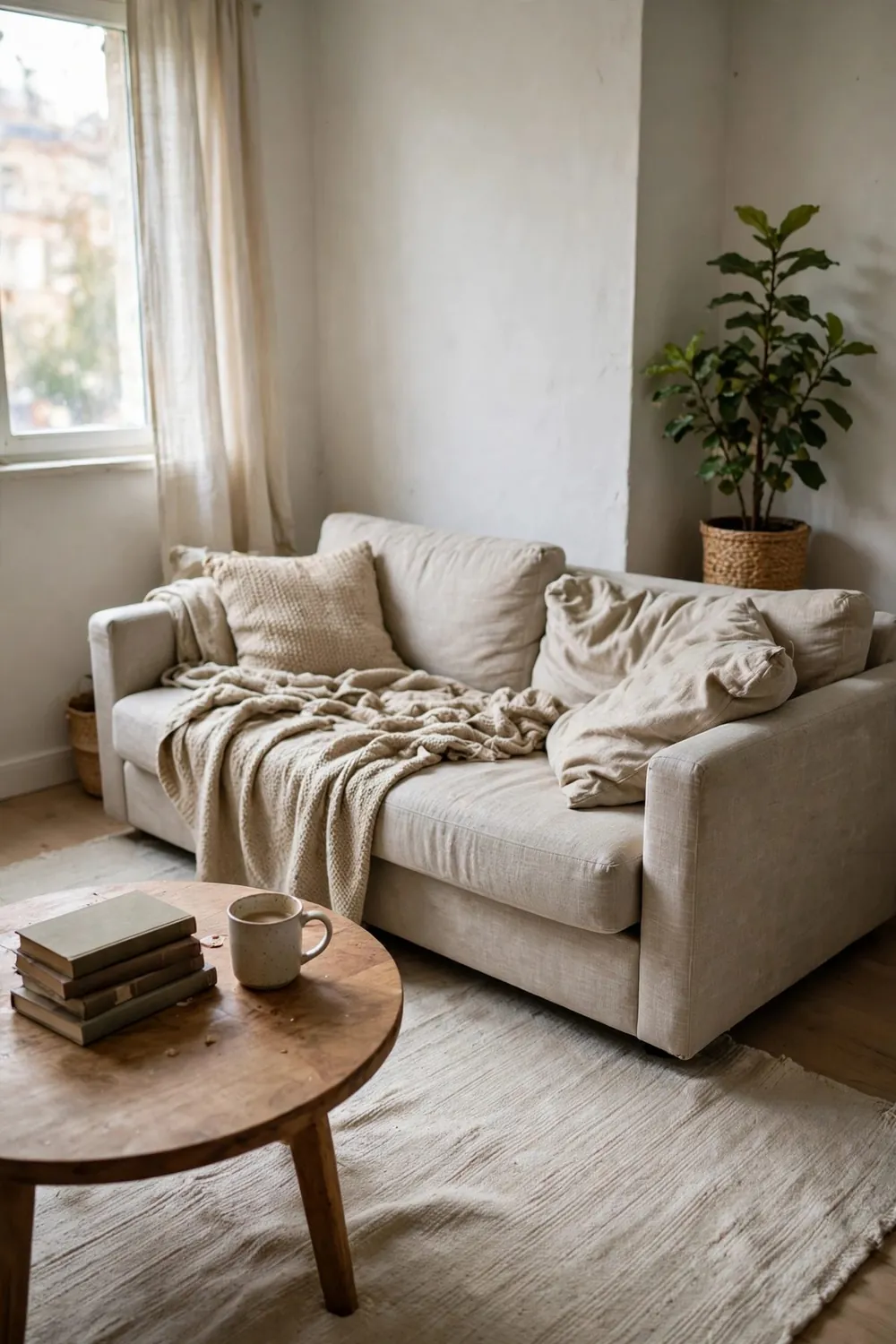
Small rooms reward every thoughtful change, so save this list and work through it in order — layout, light, then storage. You will be amazed how much space was already there, just waiting for the furniture to stop hiding it.
Keep reading: Earth Tone Living Room Ideas: Cozy Boho Color Palettes for a warm palette that suits small rooms, and 25 Cozy Winter Decor Ideas for Small Spaces to make a compact room feel like a warm hideaway when the cold arrives.


One Comment